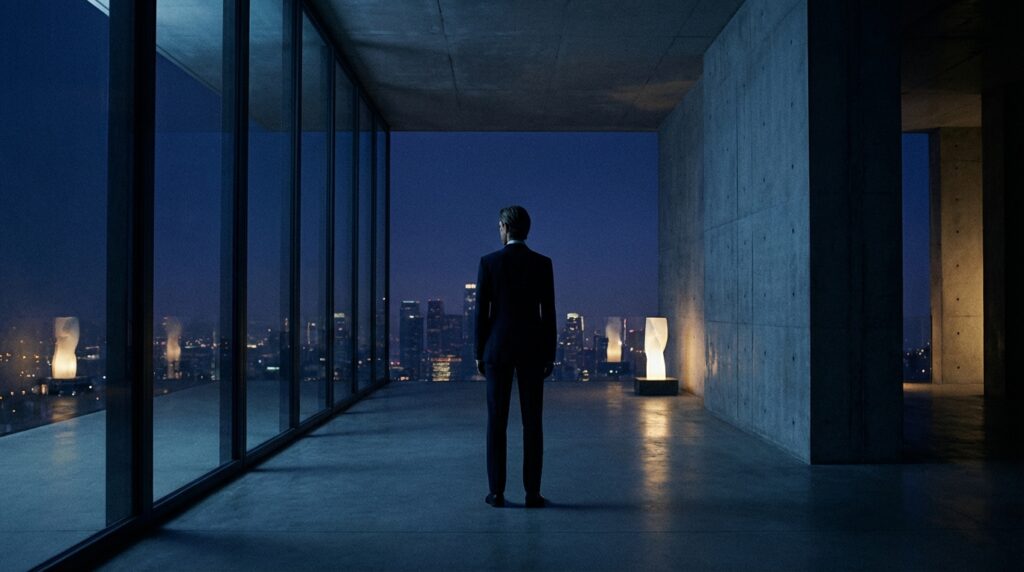

ALL NIGHT RAIN: Deep Sleep Sounds for Insomnia Relief
The Hidden Cost of Wakefulness: Why Sleep Fails Before the Body Does
Insomnia is rarely the real problem.
For high-functioning adults, what breaks first is not the ability to sleep — it is the nervous system’s capacity to feel safe enough to disengage.
If you reach the end of the day physically exhausted yet mentally alert, unable to descend into rest despite genuine fatigue, you are not facing a sleep disorder.
You are facing a regulation failure.
Modern environments quietly train the brain to remain online indefinitely. Artificial lighting, late cognitive demand, constant information intake, emotional compression, and urban noise recalibrate the nervous system toward perpetual readiness.
The body lies down.
The brain stays standing.
The Silent Insomnia of High Performers
There is a specific type of insomnia that rarely appears in clinical questionnaires.
It affects professionals who perform well under pressure, sustain complex cognitive loads, and carry responsibility without visible collapse.
By night, however, a different pattern emerges:
- The mind replays fragments of the day without narrative order
- Thoughts are not anxious, but persistent
- Silence feels loud instead of calming
- Sleep arrives late and leaves early
This is not psychological rumination.
It is autonomic inertia.
The nervous system remains partially locked in sympathetic tone, even when external demands have ceased.
In this state, traditional sleep advice fails.
Dark rooms, supplements, breathing techniques, and rigid routines cannot override a system that has not been allowed to safely power down.
Why the Brain Resists Silence at Night
Contrary to popular belief, the brain does not resist sleep because it wants stimulation.
It resists sleep because unstructured silence feels unpredictable.
From a neurobiological perspective, unpredictability equals potential threat.
When the auditory environment collapses into complete absence, the brain often compensates by generating internal noise — thoughts, memories, planning loops.
This is not failure.
It is protection.
For a nervous system conditioned by constant input, silence without structure is not rest — it is a vacuum.
And the brain fills vacuums aggressively.
Heavy Rain as a Biological Signal of Safety
This is where natural stochastic sound environments become functionally relevant.
Heavy rain is not calming because it is pleasant.
It is calming because it is predictable, broadband, and non-informational.
Rain occupies the auditory spectrum evenly, reducing the brain’s need to scan for novelty.
It masks environmental micro-noises without demanding attention.
Most importantly, it signals enclosure.
From an evolutionary standpoint, sustained rain implies shelter, reduced external activity, and lowered immediate threat.
The nervous system recognizes this pattern instinctively.
No interpretation is required.
Sleep Is Not Induced — It Is Allowed
Deep sleep does not occur because we force relaxation.
It occurs when the nervous system receives enough consistent signals that vigilance is no longer necessary.
This is why effort-based sleep strategies often backfire for cognitively active individuals.
Trying to “shut off” the mind reinforces the very circuits that keep it awake.
What works instead is environmental permission.
A sound architecture that removes decision-making, reduces contrast, and stabilizes sensory input.
Heavy rain functions as a biological boundary.
Inside that boundary, the mind no longer needs to manage the night.
It can finally step aside.
In the next block, we move beneath experience and into mechanism — examining how the nervous system transitions from alertness to sleep, and why sound regulation outperforms willpower in restoring nocturnal recovery.
From Vigilance to Sleep: How the Nervous System Actually Powers Down
Sleep is not a switch.
It is a sequence of permissions.
Before the brain enters deep sleep, it must pass through a series of neurophysiological transitions that signal safety, containment, and predictability.
When this sequence is interrupted — or never initiated — insomnia emerges, regardless of physical fatigue.
The Two Systems That Decide Sleep
At night, two major systems negotiate control:
- The Sympathetic System — responsible for alertness, vigilance, and response
- The Parasympathetic System — responsible for restoration, digestion, and repair
Contrary to popular belief, sleep does not begin when the parasympathetic system activates.
It begins when the sympathetic system releases control.
This release only occurs when the environment stops presenting unresolved signals.
Noise, irregular sound patterns, sudden silence, temperature contrast, or cognitive engagement all act as micro-alarms.
Each alarm keeps the nervous system partially online.
Why Mental Exhaustion Does Not Guarantee Sleep
Mental fatigue is often mistaken for readiness to sleep.
In reality, cognitive exhaustion can coexist with autonomic activation.
This explains the familiar paradox:
- The body feels heavy
- The eyes burn
- The mind refuses to descend
The reason is simple.
The nervous system does not sleep because it is tired.
It sleeps because it perceives completion.
Completion is a sensory signal, not a cognitive one.
Without a clear sensory boundary marking the end of the day, the system remains in monitoring mode.
Rain as a Transitional Neural Bridge
Heavy rain operates as a transitional environment.
It sits between silence and stimulation.
Unlike music, rain carries no narrative, rhythm expectation, or emotional direction.
Unlike silence, it provides continuous sensory coverage.
This combination allows the nervous system to disengage without entering uncertainty.
Neurologically, this produces three key effects:
- Reduction in auditory novelty detection
- Stabilization of alpha-theta crossover
- Downregulation of cortical monitoring loops
As these effects accumulate, internal dialogue loses functional relevance.
Thoughts do not need to be stopped.
They simply fade due to lack of reinforcement.
The Role of Duration: Why Long Rain Sessions Matter
Short sleep aids often fail because they end too soon.
The nervous system does not trust abrupt environments.
If sound stops suddenly, vigilance returns immediately.
Long-duration rain sessions create a temporal safety net.
The brain learns, implicitly, that no monitoring is required for hours.
This allows deeper sleep stages to stabilize:
- Extended slow-wave sleep
- Reduced micro-awakenings
- Smoother REM cycles
Sleep becomes continuous rather than fragmented.
Recovery becomes structural rather than accidental.
Why This Is Not Relaxation Music
Relaxation implies effort reduction.
Sleep requires control relinquishment.
Music, even calm music, invites engagement.
Rain invites withdrawal.
This distinction is critical for individuals whose nervous systems remain active after high cognitive demand.
Rain does not ask the brain to feel anything.
It asks the brain to stop managing.
In the next block, we move from mechanism to architecture — exploring how sound environments are engineered to maintain safety throughout the night and prevent relapse into wakefulness.
Nighttime Regulation: When the Nervous System Finally Lets Go
There is a precise moment during the night when insomnia either collapses —
—or tightens its grip.
This moment is not determined by fatigue, discipline, or intention.
It is determined by whether the nervous system receives a final confirmation of safety.
When this confirmation arrives, consciousness loosens without resistance.
When it does not, the mind remains online, scanning endlessly.
Protocol note: This sound environment is not designed to induce sleep.
It is designed to remove the conditions that prevent it.
Why the Brain Refuses to Sleep Before Safety Is Confirmed
Sleep is not a shutdown.
It is a permission state.
Before allowing consciousness to dissolve, the nervous system runs a final audit:
- Is the environment predictable?
- Are sensory inputs stable?
- Is there any unresolved threat?
If any of these remain ambiguous, the system delays entry.
This is why exhaustion alone does not guarantee sleep.
And why many people feel most alert precisely when they want to rest.
Rain as a Final Safety Signal
Heavy rain functions as a biological override.
Not by calming thoughts — but by eliminating the need for vigilance.
Its continuous broadband structure creates:
- Auditory closure
- Predictive certainty
- Sensory redundancy
When nothing new can enter the sound field, nothing needs to be monitored.
At this point, the nervous system stops asking questions.
This is the moment sleep begins to emerge naturally.
The Dissolution of Nighttime Rumination
Nighttime rumination is often misunderstood as psychological.
In reality, it is biological vigilance expressed as thought.
When the body no longer needs to stay alert, thought loses its fuel.
Ideas slow.
Narratives fragment.
Inner dialogue fades — not because it was silenced, but because it became unnecessary.
Why Long-Form Sessions Matter for Insomnia
The nervous system does not trust short solutions.
It responds to continuity.
Long, uninterrupted rain sessions communicate:
“Nothing will change while you are gone.”
This message is critical for deep sleep and insomnia relief.
It allows the brain to descend without keeping a guard awake.
In the next block, we examine what happens after deep sleep — and how proper nocturnal recovery reshapes cognitive clarity, emotional stability, and baseline resilience the following day.
Sleep Architecture: Designing a Sound Environment the Nervous System Can Trust
Deep sleep does not emerge from comfort.
It emerges from environmental reliability.
The nervous system continuously evaluates one core question:
“Is this environment stable enough for me to disengage?”
If the answer is uncertain, sleep remains shallow — regardless of fatigue level.
The Concept of a Cognitive Shelter
Throughout human evolution, sleep occurred inside shelters.
Not silent shelters — but predictable ones.
Wind, rain, distant water, and consistent natural rhythms signaled protection, not danger.
The modern bedroom, paradoxically, often lacks this signal.
Urban silence is artificial.
It contains gaps, sudden sounds, mechanical hums, and irregular disturbances.
To the nervous system, this equals unfinished monitoring.
A properly designed rain soundscape recreates the missing shelter layer.
It forms what we call a Neural Containment Field.
Why Heavy Rain Works Better Than Light Ambience
Not all rain is equal.
Light rain contains dynamic micro-variations that invite attention.
Heavy rain, when engineered correctly, behaves differently.
It creates a dense, broadband sound layer that:
- Masks environmental intrusions
- Eliminates sudden acoustic contrast
- Removes the need for auditory vigilance
In neurobiological terms, this produces a phenomenon known as:
Auditory Saturation Without Stimulation
The cortex receives continuous input, but no actionable information.
When information content drops to zero, monitoring ceases.
Insomnia as a Boundary Failure
Most insomnia is not a sleep disorder.
It is a boundary disorder.
The line between day and night never fully closes.
Emails, screens, unresolved tasks, and cognitive residue leak into the sleep window.
Rain functions as a boundary enforcer.
It does not relax the mind.
It seals the perimeter.
Once the perimeter is sealed, internal activity loses relevance.
The Importance of Continuous Coverage
Sleep depth depends on continuity.
Each micro-awakening resets part of the recovery process.
Sound interruptions — even brief ones — force the nervous system to reassess safety.
This is why short loops, ads, or dynamic transitions sabotage sleep.
A long, uninterrupted rain session creates what we call:
Temporal Certainty
The brain no longer needs to check the clock.
Time awareness dissolves.
This allows the system to descend beyond surface sleep stages.
Hardware as Part of the Sleep Architecture
Environmental sound design only works if it reaches the nervous system without interference.
External noise breaks containment.
This is why immersion hardware matters at night.
For sleep-specific protocols, isolation must be passive, not stimulating.
Well-fitted headphones or sleep-dedicated audio devices maintain the sound field without pressure or discomfort.
This transforms the bed into a sealed neural environment.
Inside this environment, the nervous system stops negotiating.
It yields.
In the next block, we move deeper — examining how insomnia, anxiety, and nighttime rumination dissolve when the nervous system no longer needs to defend consciousness.
After Deep Sleep: How the Brain Reboots Cognitive Clarity
The true value of deep sleep is not felt during the night.
It is revealed the next morning.
Not as motivation.
Not as energy.
But as the absence of friction.
The Morning Without Residue
After a night of uninterrupted, regulation-driven sleep, the brain wakes differently.
Thoughts do not rush in.
The body does not feel heavy.
Attention emerges without being summoned.
This is what we call low-residue awakening.
It indicates that the nervous system completed its full nocturnal cycle instead of fragmenting it.
Sleep as Cognitive Defragmentation
During deep sleep, the brain performs a process similar to system defragmentation.
Unresolved signals are cleared.
Threat markers are downgraded.
Emotional noise is decoupled from memory.
What remains is signal.
This is why problem-solving often feels effortless after restorative sleep.
The brain is no longer compensating.
Why Insomnia Creates Artificial Anxiety
Chronic sleep fragmentation produces a false emotional baseline.
The brain interprets lack of recovery as ongoing threat.
This elevates cortisol even in neutral conditions.
Over time, the individual begins to feel anxious without context.
This anxiety is not psychological.
It is physiological residue.
Remove the residue — and the anxiety dissolves.
The Link Between Sleep Depth and Focus Stability
Focus does not originate from effort.
It emerges from stability.
After deep sleep, the prefrontal cortex operates without defensive load.
Working memory expands.
Task-switching decreases.
Attention sustains itself.
This is why elite performers protect sleep as a strategic asset.
Not for rest — but for clarity.
Rain-Based Sleep as a Reproducible Protocol
The advantage of rain-based sleep environments is consistency.
The nervous system learns the pattern.
Night after night, the same signal produces the same response.
This predictability rebuilds trust between consciousness and the body.
Once trust is restored, sleep stops being negotiated.
It simply happens.
In the final block, we integrate sleep, silence, and focus into a single sustainable rhythm — one that supports long-term cognitive performance without burnout.
From Sleep to Sovereignty: Building a Sustainable Neural Rhythm
Deep sleep is not an isolated event.
It is a structural pillar of cognitive sovereignty.
When sleep is stabilized, silence becomes accessible.
When silence is accessible, focus emerges without force.
This sequence is not motivational.
It is biological.
The Weekly Neural Cycle
High performers do not operate in constant intensity.
They operate in cycles.
A sustainable neural rhythm follows a simple arc:
- Midweek accumulation
- End-of-week discharge
- Nightly deep recovery
- Next-day cognitive clarity
Rain-based sleep environments belong to the recovery phase.
They are not used to escape life.
They are used to restore the system that engages with it.
Why This Is Not “Sleep Content”
What you experienced in this protocol is not entertainment.
It is not background sound.
It is not relaxation content.
It is functional audio.
Designed to regulate, not stimulate.
Designed to disappear, not impress.
The goal is not emotional response.
The goal is system alignment.
Long-Term Effects of Consistent Neural Environments
When the nervous system receives the same recovery signal repeatedly, it adapts.
Sleep latency decreases.
Night awakenings reduce.
Morning clarity increases.
Mental resilience stabilizes.
Over time, the individual stops “trying” to sleep.
Sleep becomes an automatic response.
The Role of Isolation in Modern Performance
Modern environments are hostile to biological rhythms.
Noise, light pollution, and digital intrusion fragment recovery.
This is why isolation is not optional.
It is engineered.
Noise-canceling headphones.
Predictable sound architecture.
A sealed sensory container.
Together, these form a temporary refuge where the nervous system can disengage safely.
Where This Protocol Fits in the Larger System
This rain-based deep sleep protocol is one node in a larger neural architecture.
Silence protocols discharge accumulated stress.
Sleep protocols restore baseline regulation.
Focus protocols activate productive states without anxiety.
Each phase supports the next.
No phase replaces the other.
Closing Integration
If you allow the night to complete its work, the day will not demand effort.
Clarity will arrive quietly.
Focus will follow naturally.
And productivity will no longer feel like pressure.
This is not optimization.
It is alignment.
The system works when the system is respected.
This protocol remains available as part of the Alien Dub Treehouse neural library.
Use it consistently.
Let it disappear into the night.
And let the morning take care of itself.